
Go-to-Market Is a Portfolio Decision, Not a Post-Launch Document
Segment, channel, and value metric are focus, budget, and metric decisions you make deliberately from evidence and record in the ledger, not a document written after the build.
Go-to-market is a decision that shapes the build, not a document written after it.
Most teams treat go-to-market as a document assembled after the product ships: the launch plan, the positioning, the pricing page, all written once there is something to sell. That sequence made sense when building was slow. It does not survive a portfolio run through agents, where the product gets built against whatever the operator already decided, and whatever they did not decide gets chosen by default.
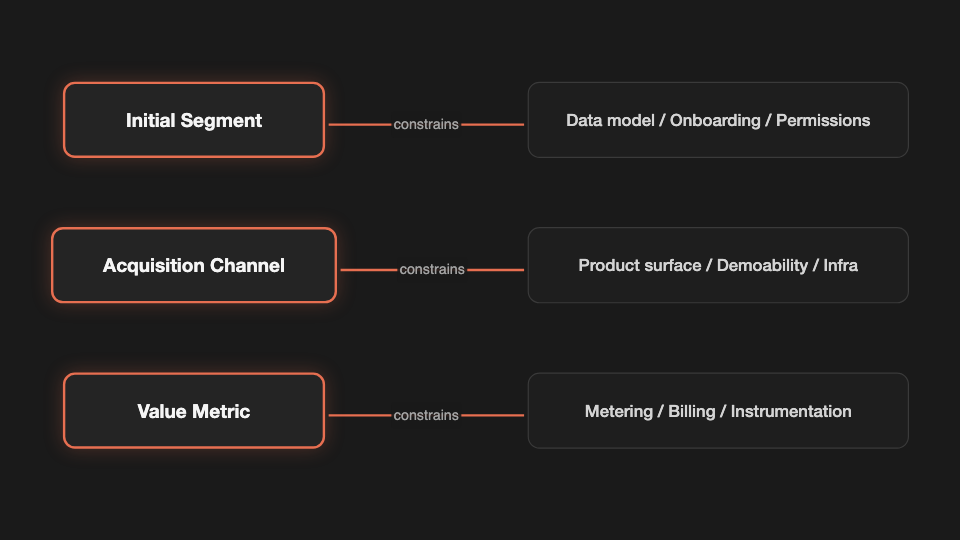
Three go-to-market choices are not post-launch tactics at all. They are decisions that determine what the product becomes: who you serve first (segment), how those people find you (channel), and what you charge them for (value metric). Each one is a call the operator makes deliberately, from the week's evidence, and records: a focus, budget, or metric decision, not a paragraph filled in later. Make them early and the build follows the bet. Defer them and the build commits to the most generic version of each, and you find the mismatch weeks in.
Founders debating this in June 2026 are still largely arguing about whether go-to-market strategy belongs at the early stage at all. [1] That is the wrong question. The right question is whether these three calls get made deliberately and recorded, or made by default and discovered later. With agents collapsing the time from decision to shipped software, the answer has shifted.
The "figure it out later" assumption was fine when building was slow
The conventional approach made sense under the old economics. When shipping a feature took three weeks and a planning conversation, the lag between deciding and building gave go-to-market calls time to catch up. You would hire a marketing person, write the launch plan, figure out the channel, and none of it fell behind the build schedule, because the build schedule was slow.
That lag is gone. When an agent can execute a decision in an afternoon, whatever you did not decide becomes a default the agent picks for you. As I wrote in building the wrong thing faster, speed is an amplifier, and it amplifies correct direction and wrong direction equally.
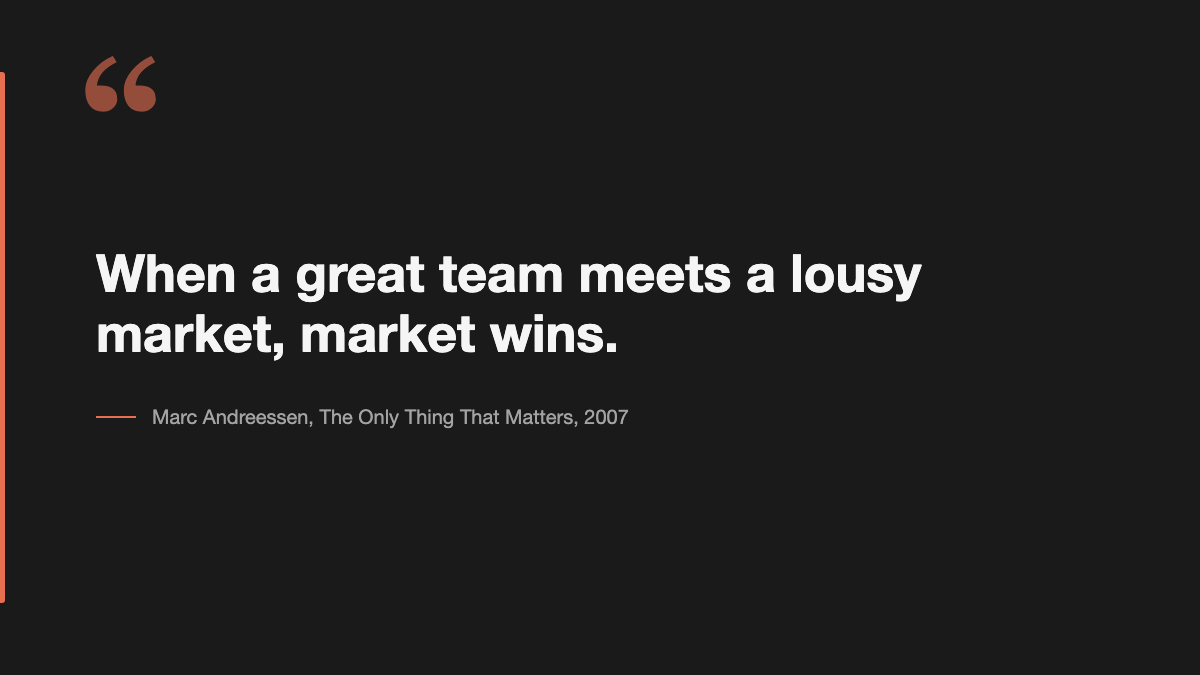
Marc Andreessen's framing from 2007 still holds: "When a great team meets a lousy market, market wins." [5] The market choice is embedded in these three go-to-market decisions. They shape the product. Defer them and the product gets built against an implicit, unexamined version of each, usually the most generic one.
Variable 1: The segment you choose determines your data model
Bill Aulet's disciplined entrepreneurship method starts with a single question before anything else: who is your customer? Not abstractly. Specifically. Pick a beachhead market. Identify the next ten customers. Build the persona from that exact group, before scaling the product to serve anyone else. [4] Aulet's sequencing is not about marketing; it is about what the product needs to do for a specific kind of person before generalization makes any of it mean less.
The segment choice is a focus decision, and it is not abstract. It decides the multi-tenancy model, the roles and permissions schema, the onboarding flow, and which integrations must ship at launch versus which can wait. A product built for individual developers looks structurally different from one built for small engineering teams, which looks different again from one built for enterprise buyers. These are not the same product at different pricing tiers. They are different products.
Devin's initial launch illustrates this plainly. The decision to enter via developers with technical proof (SWE-bench scores, benchmark results, code-execution demonstrations) was not a marketing choice. It was an architecture choice. The product had to be benchmark-shaped and technically verifiable before any other feature was considered. That constraint came directly from the segment decision, not from positioning written after the fact. [2]
Variable 2: Your acquisition channel is a product surface requirement
The acquisition channel is not a marketing question you answer after launch. It is a decision about what the product has to be.
A Product Hunt launch demands a product with zero-setup demoability. Manus prioritized Product Hunt's number-one slot and short-form video demos, then built the viral mechanics into the product itself rather than bolting them onto a landing page. [2] The product had to be instantly demonstrable by a stranger in under two minutes. That is a product constraint, not a task for the marketing team.
An open-source and community channel demands something structurally different. AFFiNE invested in Discord presence, GitHub activity, and documentation before allocating anything to paid acquisition, because for an open-source tool, the community is the product surface. [2] You cannot retrofit that. A product built for self-serve with standard onboarding does not become a community-first product by starting a Discord server after launch.
Enterprise sales creates a third set of requirements: admin panels, SSO, audit logs, and for AI products going into security-conscious organizations in 2026, often on-premises or localized deployment to clear vendor reviews. [3] An AI product built with the channel decision left unmade produces a self-serve web app by default. If the plan was always enterprise sales, that default is a compatibility gap before the first customer conversation.
The pattern is consistent across all three cases. The channel tells you what the product needs to be, and once the product is built for the wrong channel, changing it is not a pivot. It is a rebuild.
Variable 3: Your pricing model tells the product what to measure
What you charge for determines what the product must track, meter, and surface to users.
Usage-based pricing on any unit (API calls, active seats, tasks completed, documents processed) requires that unit to be measured accurately from the first user interaction. Adding metering after the product ships means rework in the data model, the billing integration, and the instrumentation layer. This is not a hypothetical engineering concern. It is the actual build consequence of deciding the pricing model after the build.
On AI products, the stakes are steeper. SEM Nexus's 2026 analysis of AI startup go-to-market approaches states directly: "Every time a user interacts with your AI, you pay inference fees... blindly copying [per-seat] pricing will destroy your profit margins." [3] That is a vendor's framing, so take it as attributed analysis rather than neutral fact, but the underlying cost-structure argument is correct. The value metric you charge on needs to reflect the cost you incur. Per-seat pricing on a product with high per-use inference costs is not a pricing choice; it is a liability that becomes legible at scale.
The practical implication is narrow: name the value metric. Not the billing platform, not the final pricing tier, just the unit. In the portfolio model that is a metric decision, the KPI a product owes, and it determines what the product must instrument from day one. For the full unit-economics argument, unit economics and the value metric decision covers the pricing-as-decision case in detail.
The counterargument worth taking seriously
The objection here is reasonable. Early-stage go-to-market pivots are common. A founder who locks a segment and channel before any user feedback might cement a wrong assumption faster than they can discover it. Aulet's framework names the beachhead as a hypothesis to be validated, not a permanent commitment. [4]
That is a real objection, and it does not resolve the problem.
The question is not whether to decide now versus later. The question is what it costs to be wrong at each moment. Deciding you were wrong about your initial segment before you built the permissions model costs nothing. Discovering it after launch and rebuild costs runway. The cost of revising a wrong assumption scales with how deeply the original assumption is embedded in the build, and these three decisions embed themselves quickly.
Founders debating this in June 2026 are largely arguing past that cost asymmetry. [1] The case for deferring these calls is "things change." The case for making them early is "things change, but some things are far cheaper to change before the build than after." Both are true, and a decision you record is not a decision you are stuck with: when the evidence moves, you supersede the old call. The relevant question is which category these three fall into, and the answer is clear. They are direction-setting decisions, not distribution tactics.
Three decisions to record before the build
These are not a document to write later. They are three decisions to make now and record where the work can see them, so the build follows the bet instead of a default.
Segment (a focus decision). Who are the first ten users, specifically? A team, an individual, an enterprise buyer? That call sets the data model.
Channel (a focus and budget decision). Where do the first hundred users actually come from, and what does the product have to be, demoable, documentable, or deployable, for that channel to work?
Value metric (a metric decision). What unit does the product charge on, and is it tracked from day one?
Agents execute the decisions you have recorded. The ones you leave unrecorded, they resolve by default: silence on channel produces a generic self-serve web app; silence on the value metric produces no metering at all. A decision made by default is still a decision. It is just one nobody chose, and one nobody can defend later.
The three decisions (segment, channel, value metric) arrive as constraints whether or not you make them on purpose. The choice is not whether to decide. It is whether the call gets made deliberately, from the evidence you have, and recorded, or made by default and discovered in the rework. When agents do the building, an unrecorded decision is the most expensive kind.
Turn this week's evidence into decisions you can defend.
References
- Hacker News. "Ask HN: Do you need go-to-market strategy at early stage?" 2026-06-09. https://news.ycombinator.com/item?id=48456858. Accessed 2026-06-22.
- iris1031. "Go-to-Market Strategy: The Complete 2026 Playbook for Startups." DEV Community, 2026-04-03. https://dev.to/iris1031/go-to-market-strategy-the-complete-2026-playbook-for-startups-210j . Accessed 2026-06-22.
- SEM Nexus. "The 2026 Go-To-Market (GTM) Strategy for AI Startups." 2026-05-05. https://semnexus.com/go-to-market-gtm-strategy-ai-startups/ . Accessed 2026-06-22.
- Aulet, Bill. "Disciplined Entrepreneurship: 6 questions for startup success." MIT Sloan Ideas Made to Matter. https://mitsloan.mit.edu/ideas-made-to-matter/disciplined-entrepreneurship-6-questions-startup-success . Accessed 2026-06-22.
- Andreessen, Marc. "The Only Thing That Matters." Pmarchive, 2007. https://pmarchive.com/guide_to_startups_part4.html. Accessed 2026-06-22.