
Why Building the Wrong Thing Faster Is the New Startup Failure Mode
AI collapsed the cost of building. The cost of being wrong did not change. Find out why building the wrong thing faster is the new startup risk.
You can now build a working product in a sprint, a credible prototype in a weekend. The feature that once required a hiring conversation now takes an afternoon. The constraint most early-stage teams spent years complaining about, that building takes too long and costs too much, is functionally gone.
Building the wrong thing faster is the new risk, and the constraint that actually kills most startups is still exactly where it was.
According to CB Insights, poor product-market fit is the root cause of startup failure in 43% of cases. [1] That figure is not new, and it did not move when AI code generation arrived. What moved is everything upstream: the cost to build, the time to deploy, the number of features a small team can ship in a month. Speed is real. The problem is that it now arrives well ahead of the signal that would tell you whether you are building the right thing.
AI collapsed the cost of execution. It did not touch the cost of being wrong about what to build. That asymmetry is worth sitting with, because fast shipping has a way of feeling like it resolved the question.
The execution barrier came down fast
The scale of this shift deserves to be taken at face value before anyone questions what it means.
Sundar Pichai stated publicly that 75% of new code at Google is now AI-generated. [4] That is an outlier by any measure, but the direction is consistent. Satya Nadella put Microsoft's figure at 20 to 30%. GitHub's data across its broader user base puts AI's share at roughly 41%. The range across these three data points is wide. The trend they share is not.
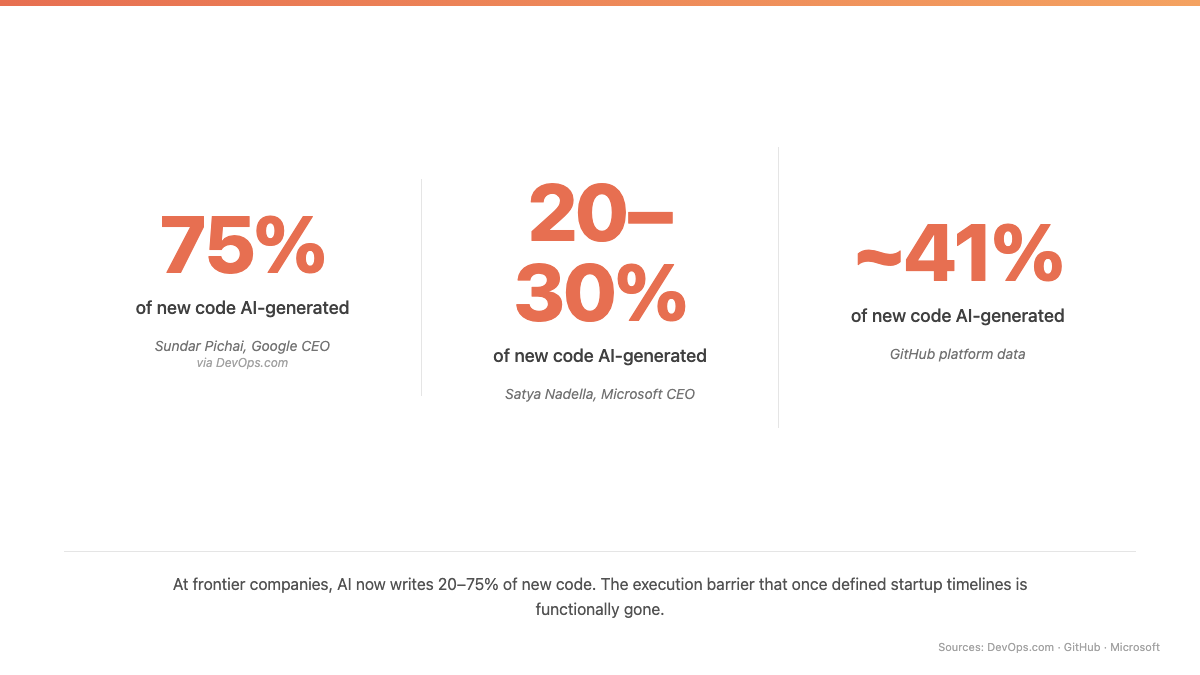
For a startup whose entire pitch to itself was "we move faster because we're small," this is both good news and a structural change in the terms of competition. The execution advantage that once separated agile startups from slower incumbents is compressing across the board. But more relevant to the failure-rate conversation is what else compressed: the natural rate limiter on how quickly you could burn through runway on a bad idea.
In the pre-AI baseline, building a feature took long enough that you had at least some forcing function toward thinking before you shipped. A three-week build cycle pushed you, weakly but genuinely, to interrogate the bet before you made it. When that cycle is now three days, the forcing function is gone. You can arrive at the discovery that you built the wrong thing before the previous sprint has had time to produce any signal at all.
The execution barrier came down faster than most teams expected, and it kept coming down. Output velocity and failure rate are different graphs. They tend to get conflated because the pace of the former makes it easy to assume the latter moved too.
The speed you feel is not the speed you have
There is a piece of research worth looking at directly before drawing conclusions about what AI actually does to your pace.
METR published a randomised controlled trial in July 2025: 16 experienced open-source developers, 246 real GitHub issues, a controlled comparison of working with and without AI tools. Before the study, participants expected AI to speed them up by 24%. After it ended, they still believed they had been faster, by roughly 20%. [2]
They had not been. They had been 19% slower.
This is not a blanket argument that AI tools never help. For specific tasks on specific codebases the productivity gains are real and documented. But this particular result is about a gap that matters more than the absolute productivity number: the gap between felt confidence and measured output. These were experienced developers, working on their own open-source projects, using tools they had chosen. Their perception was consistent and wrong, before, during, and after the work.
A founder running a sprint with this kind of miscalibration will make decisions as though the feedback loop is tight when it is not. They ship three features in the time it used to take to ship one, feel the acceleration, and read it as progress. The iterations feel like learning. Each one might be retesting a hypothesis the previous one already ruled out, only faster and with higher confidence.
This is the same structural problem that surfaces when AI faithfully builds what you specify rather than what you need. The execution layer will do whatever you ask it to do, quickly. The judgment about what is worth asking sits somewhere the model cannot reach.
The killer was never the code
Marc Andreessen made the central point in 2007, and it has not weakened with age.
"When a great team meets a lousy market, market wins. When a great product meets a lousy market, market wins." [3] He called market the only thing that matters, and the argument was not that teams and products are unimportant. It was that they are insufficient. You can have the best engineers, the cleanest codebase, and the fastest iteration cycle, and a market that does not want what you built. The market wins.
The CB Insights data on startup failures makes the same point quantitatively. Poor product-market fit is the root cause in 43% of cases. [1] The proximate cause across 70% of failures is running out of capital, but when you trace it back, the money ran out because the product was not pulling people in. Execution quality did not save it. Speed did not save it.
What changed with AI is the rate at which a team can arrive at this outcome. In the pre-AI timeline, discovering you had built the wrong thing often took a full engineering cycle: six months, a few planning reviews, a board conversation. The market signal arrived slowly enough that you had natural checkpoints to interrogate the direction before committing the next quarter to it.
The same discovery can now happen in three sprints. The bill arrives faster because the building is faster. The market signal still takes as long to collect as it ever did.
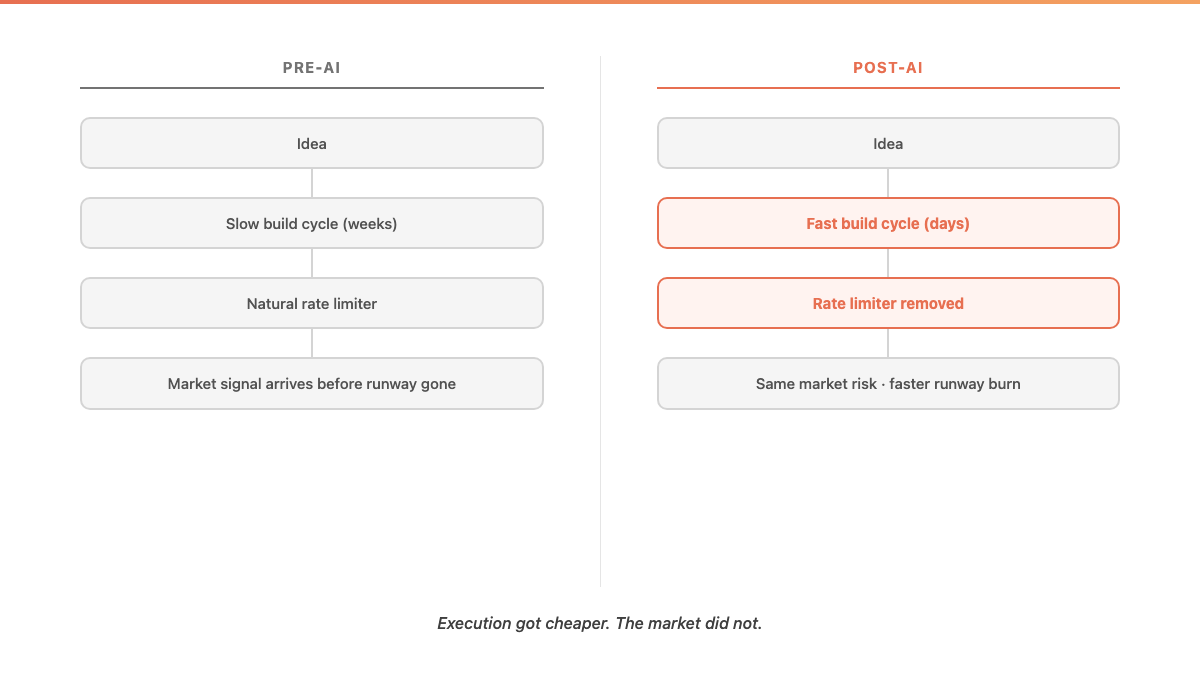
The asymmetry is the thing worth holding onto. Execution cost collapsed. Market risk did not. That gap between the two is where the new failure mode lives.
Building the Wrong Thing Faster: When Fast Iteration Loses Direction
There is a confusion worth naming precisely, because it is not obvious from the inside.
Fast iteration, at its best, is a method for collecting signal. You ship something small, observe how people respond, and update your model of what they actually need. The iteration loop is a learning loop. That is the valuable thing about it.
But iteration requires something to iterate toward: a falsifiable claim about what a user needs and why your approach addresses it. Without that anchor, iteration is motion. You ship, you look at the numbers, nothing notable moves, and you ship the next thing. The feedback loop feels tight because the cycle is fast. The drift is invisible because each individual step looks like progress.
The pre-AI version of this failure mode was slower and more visible. If a feature took three weeks to build and three weeks of flat usage data to assess, you had six weeks before the next bet. Not a lot of time, but enough to ask whether the direction was right. That pause is now compressed on one side only. The team that can ship in three days will also fail to notice it is drifting for a much longer period before the aggregate absence of signal becomes legible.
Naming the pattern makes it easier to catch: fast iteration masquerading as product direction. The diagnostic is not complicated. The difference between shipping fast and learning fast is whether each release tests a falsifiable product hypothesis. If you cannot write down in a sentence what you would need to see to conclude the feature worked, and what would tell you it had not, you are shipping motion, not tests.
Turning a week of evidence into decisions you can defend is not a slowdown. It is the step that determines whether the speed is useful.
The pre-AI failure mode was "couldn't build it." The post-AI failure mode is "built the wrong thing, fast, and the tight feedback loop felt like validation."
Speed is an amplifier. Building the wrong thing faster is how teams arrive at the familiar outcome (no market fit) before they have time to notice. In the right direction, speed closes the gap; in the wrong one, the runway goes sooner. What AI removed is the friction that once gave wrong direction time to surface before it consumed all the runway. The work of knowing which direction is right was not touched.
That work is domain judgment: understanding the problem well enough to form a hypothesis worth testing quickly, and being honest about the difference between a sprint that produced a signal and one that just felt productive. No model automates that. No faster build cycle substitutes for it. The question of what to build remains exactly as hard as it was before anyone could build it in a weekend.
If this reframe landed for you, send it to a co-founder or PM who's been shipping fast.
References
- CB Insights. "Why Startups Fail: Top Reasons." https://www.cbinsights.com/research/report/startup-failure-reasons-top/ . Accessed 2026-06-12.
- METR. "Measuring the Impact of Early-2025 AI on Experienced Open-Source Developer Productivity." https://metr.org/blog/2025-07-10-early-2025-ai-experienced-os-dev-study/ . Published 2025-07-10. Accessed 2026-06-12.
- Andreessen, Marc. "The Only Thing That Matters." Pmarchive, 2007. https://pmarchive.com/guide_to_startups_part4.html. Accessed 2026-06-12.
- DevOps.com. "Google CEO Says 75% of New Code is AI-Generated." https://devops.com/google-ceo-says-75-of-new-code-is-ai-generated/ . Accessed 2026-06-12.